At a glance
- Distinguish monks, Buddha images and amulets before comparing interpretations.
- MyHora, Sanook and TrueID differ in some subheadings and number sets.
- Predictions about health, fortune and work belong to the publishers’ belief content.
- Record events and feelings before searching, then keep later interpretations separate.
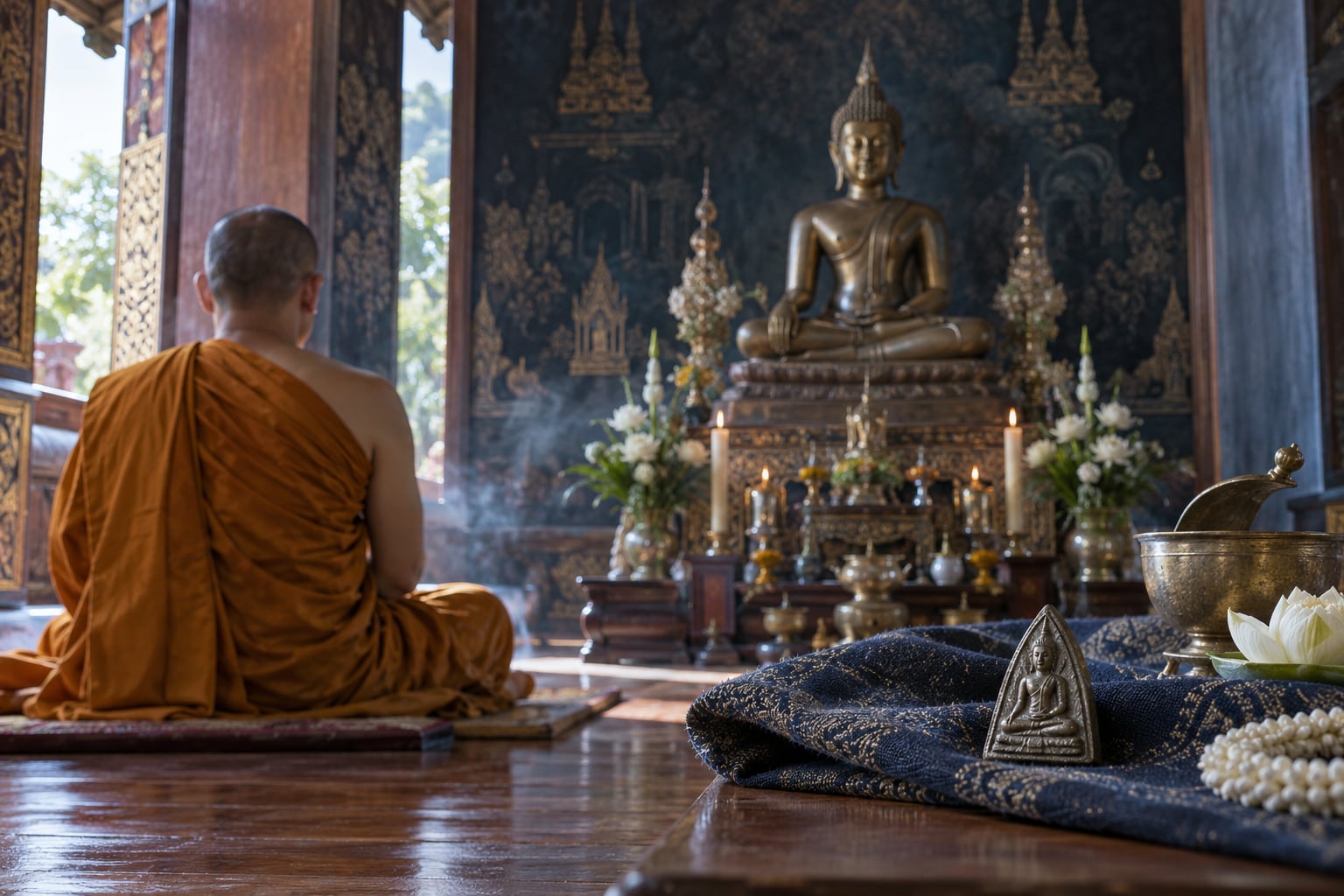
A dream about phra may leave you feeling peaceful, then puzzled when different guides offer different answers. The Thai word can refer to a monk, a Buddha image or an amulet. Remembering which appeared in your dream is a useful first step.
We compare MyHora, Sanook and TrueID, keeping both their similarities and their differences visible and naming the sources of number examples. These are the publishers’ dream interpretations, not Buddhist teachings or promises of a prize.
Identify the monk, image or amulet in your dream before choosing a guide’s interpretation.
Religious images and auspicious interpretations
A Buddha image or amulet in a dream may leave the dreamer feeling reassured. MyHora places devotional images among auspicious dreams and associates them with later good fortune. TrueID also describes Buddha-image dreams in terms of receiving good things, within its belief-based interpretation.
These are predictions by individual publishers, not endorsements by a temple or statements of religious doctrine. Dream-interpretation articles should therefore be distinguished from Buddhist teaching, even where both use familiar religious imagery.
Three sources do not give identical numbers
MyHora’s phra category includes 88 and 27. Sanook distinguishes monks from Buddha images and gives examples such as 91 and 92 for Buddha images. TrueID’s Buddha-image section includes 82 and 27. The differences can be checked on the linked original pages.
A repeated number does not establish a greater chance of winning. Different numbers also do not require us to choose a winning guide. We are comparing interpretation traditions that do not all use the same framework.
Record your dream before opening a guide
Write briefly what a monk was doing, where a Buddha image stood, or whether you received an amulet. Recording this before reading reduces the risk of adding a newly encountered interpretation to your memory of the dream.
If the dream encourages a kind action, you might contact an elder, take time to rest or make a donation within your means. Such an action need not be tied to a promise that money or a lottery prize must follow.
Match monks, Buddha images and amulets to the actual scene
A monk is a person whom the dreamer may meet, speak to or make an offering to. A Buddha image occupies a place, while an amulet may be received, worn or lost. The terms are related in Thai but the events differ. A monk passing the house and arranging a household shrine are different scenes even if both feel peaceful.
Search with an object and an action, such as a monk collecting alms or worshipping a Buddha image, then read the publisher’s actual headings. If you remember only something resembling an amulet, do not invent its number, colour or name to obtain a more specific category. Incomplete memory should remain incomplete rather than being rewritten by the guide.
How similarly do the websites organise their categories?
MyHora returns several related categories from a keyword search. Sanook uses an article bringing together events involving phra, while TrueID more explicitly separates the number of monks and particular activities. These editorial differences help explain why the same search term produces different interpretations. Start with the heading inside the page, not just its search-result title.
The comparison table keeps monks, Buddha images and amulets under the headings used by each source. It does not collect every number on every page. Instead, it lets you follow a number back to the particular dream the publisher was describing.
Dreams of sermons and listening to teachings
TrueID has a sermon heading and MyHora a listening-to-teachings category. The activity matters, not merely the presence of someone dressed as a monk. If you remember words, distinguish what you recall hearing from your own interpretation. Do not complete a fragmented sentence or describe it as a sacred command simply because it occurred in a dream.
Your response after waking may matter more than decoding every word. You may want to apologise to someone or make room for quieter time. These remain personal choices and do not require proof of an omen. To check whether remembered words agree with Buddhist teaching, consult a source that directly explains those teachings, beyond dream websites.
One monk or several: which details matter?
TrueID separates dreams of one and two monks, while Sanook includes several monks. Some publishers use count as an interpretive detail, but that does not create a shared number-by-count table. If you saw several monks without counting them, retain that description instead of choosing an exact number to complete a prediction.
Also distinguish who acted: making an offering yourself, watching someone else do so and receiving something from a monk are different roles. Recording who did what and where is often more useful than counting every person. Some details are remembered; others are guesses made after waking.
Temple imagery is different from religious authority
A dream page establishes how its publisher interprets a symbol. It does not establish that a monk, a temple or a religion endorses the prediction. A religious illustration is not evidence of review by a religious expert. Look for the actual publisher and heading instead of treating the image as a credibility seal.
A dream may recall an elder, a temple visit or a family amulet. You can tell that memory directly—for example, remembering a grandfather’s amulet and his advice about honesty. The emotional meaning remains intact without adding that the amulet communicates a future lottery result.
What sleep information adds to the discussion
NHLBI explains that dreams usually occur during REM sleep and that REM periods increase later in the night. This describes dreaming as part of sleep. It does not provide a dictionary linking Buddha images to future events or show that every near-morning dream comes true. Sleep information and belief guides answer different questions.
You can also record personal context, such as a recent temple visit, a temple image seen on a phone or a conversation about a family keepsake. This is a suggestion for understanding your story, not a diagnosis of the dream’s cause. Similar images can be connected to different memories for different people.
An example of a checkable dream record
Suppose you remember entering a temple-like building, seeing a Buddha image on a table and feeling calm. The first entry should contain those details and uncertainties, such as not remembering how many images there were. Add a separate entry identifying which website’s Buddha-image article you read and when. This keeps later numbers and warnings from becoming retrospective dream details.
When sharing the story, start with your memory and then identify how each source interprets it. If someone has another guide, retain both explanations without selecting a winner. The value of comparison lies in understanding sources and conditions, rather than fitting later life events to whichever prediction looks most accurate.
Record what you remember without adding details to fit a guide.
Separate the search terms and the claims of each publisher.
Keep sources alongside explanations and numbers.
Compare sources and observations
Each source answers different questions. This table distinguishes comparable information from details that depend on the original context.
| Source | Category compared | Belief-based interpretation | Annlek observation | References |
|---|---|---|---|---|
| MyHora | Phra / Buddha images / amulets | Auspicious devotional images; examples 88 and 27 | Several objects share a category; read the accompanying explanation. | References[1] |
| Sanook | Buddha images | Peace for the dreamer and family; examples 91 and 92 | Monks and Buddha images are separate headings. | References[2] |
| TrueID | Buddha images | Positive interpretations; examples 82 and 27 | Further distinctions cover monk counts and activities. | References[3] |
| NHLBI | Sleep stages | Explains dreams and REM sleep | Sleep information, without number sets or individual predictions. | References[4] |
Questions & answers
Further answers to questions that often arise when reading this topic
Does dreaming of phra guarantee that I will receive money?
Can monk and Buddha-image dreams use the same numbers?
Must I search for an amulet’s model if I cannot remember it?
No. Use the detail you remember. Guessing its model, year or quantity changes the starting information and does not improve the comparison. Recording uncertainty does not diminish the story’s value.
Is hearing a sermon a command to make merit?
Why does one guide give 88 and another 91?
Are near-morning dreams proven to have a special predictive meaning?
The NHLBI information explains that REM periods increase later in the night. It does not confirm that near-morning dreams predict the future. Statements about dream timing in a belief guide should remain attributed to that guide, without using REM information as proof of accuracy.
Can a recovery prediction replace health information?
What should I include when sharing this article?
Include the link, the relevant subheading and the fact that it describes a belief interpretation. A number-only image conceals whether the source concerns monks, Buddha images or amulets, as well as the source-check date. Full context lets others compare the guides themselves.
Sources and their scope
- MyHora — Dream interpretations: phra search ↗
Publisher-defined belief categories can include monks, Buddha images, amulets and worship objects. Read matching subheadings; the compared entries do not identify an ancient edition.
- Sanook — Dreams of monks and Buddha images ↗
Separates monks, images, several monks and activities. A category name should not replace every specific scene.
- TrueID Horoscope — Dreams of monks and Buddha images ↗
The source names Torah as its author. Used to compare dream categories, rather than to present interpretations as established facts.
- NHLBI — Stages of sleep ↗
NIH educational information about sleep, rather than a dream book or a test of dream-related numbers.
Sources checked on 10 October 2026 · Original sources may change